Book a review
Total Asset Control · Hong Kong

A middle-office system for independent asset managers

TAC is a middle-office system and operated service for asset managers, advisers, brokers and family offices in Hong Kong. The software reconciles statements and trades, works out fees, runs the compliance checks and prepares the reports. Our operations and compliance team investigates the exceptions. Your principals review the output and sign it.

10 yearsrunning operations for asset managers in Hong Kong
23 custodiansand brokers whose statements TAC reads
US$3.3bnof client assets checked by TAC
62,117custodian statements read and checked
25,267trades reconciled with the custodian
17 testscompliance checks, run on every transaction
The obligation

Eight Core Functions, usually covered by a few people.

Since April 2017, the SFC has asked each licensed firm to name a person in charge of each of eight Core Functions. That person answers to the board and to the SFC.

01Overall management oversight
02Key business line
03Operational control and review
04Risk management
05Finance and accounting
06Information technology
07Compliance
08AML / CFT
The gap
In a small firm, the same few managers cover most of the eight.

A small firm cannot hire eight specialists or buy the systems a large bank runs. The work gets done in spreadsheets and by hand, by people who have other jobs as well. TAC takes on the recurring part of that work.

Technology

How the checks work

1Reading the documents

TAC reads statements, client agreements and term sheets, including scanned PDFs, and turns them into structured data.

2Written rules decide

A pass or a fail comes from a written rule. Run the same input through the same rule and you get the same result.

3Totals must agree

Each file is checked against a second, independent figure, usually the total the bank printed on the statement. If the difference is not zero, the file is held and a person looks at it.

4People review exceptions

Our operations and compliance team reviews each exception. Your principals review the final output and sign it.

Each firm has its own server and its own database. One firm's data is not stored with another's.

We do not use your data to train machine-learning systems.

Your data stays in Hong Kong, or in your own cloud account if you prefer.

We adjust the service to the way your firm works.

How it works

Where the data comes from, and where it is checked

An external asset manager does not hold client money. The records sit with the custodian banks, with the product issuers and in client emails. TAC brings them into one database and checks them before anyone uses them.

Step 1Sources

Custodian banks, product issuers and client emails.

Step 2One database

Statements, trades and client records in one place.

Step 3Rules

Checks and calculations built over ten years of running operations for asset managers.

Step 4Checks

Each transaction is checked. Anything that does not agree goes to a person.

Step 5Outputs

Management reports, regulatory filings and audit logs.

Step 6Review

Our team reviews the exceptions. Your principals sign the output.

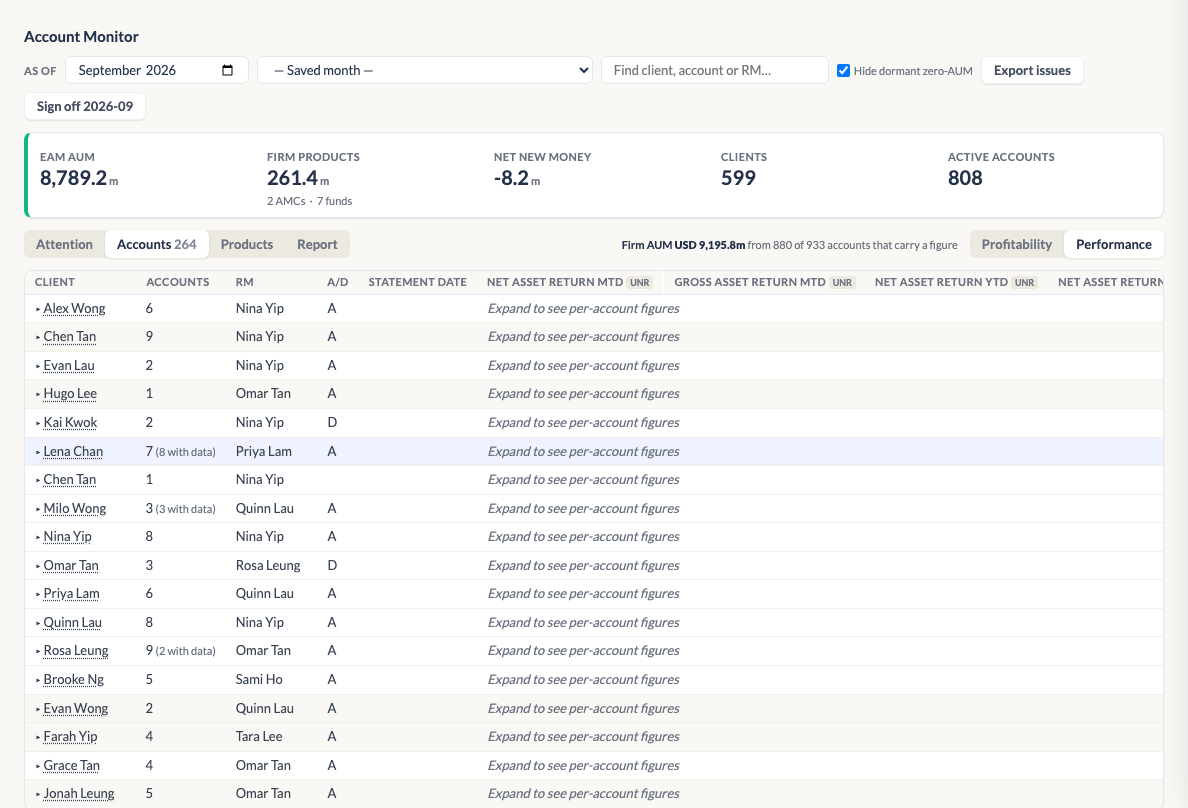
TAC Account Monitor page, with sample data
Account Monitor

Each account against its limits, using the same AUM figure as the Firm and Risk pages.

Sample data. Names and figures are made up.
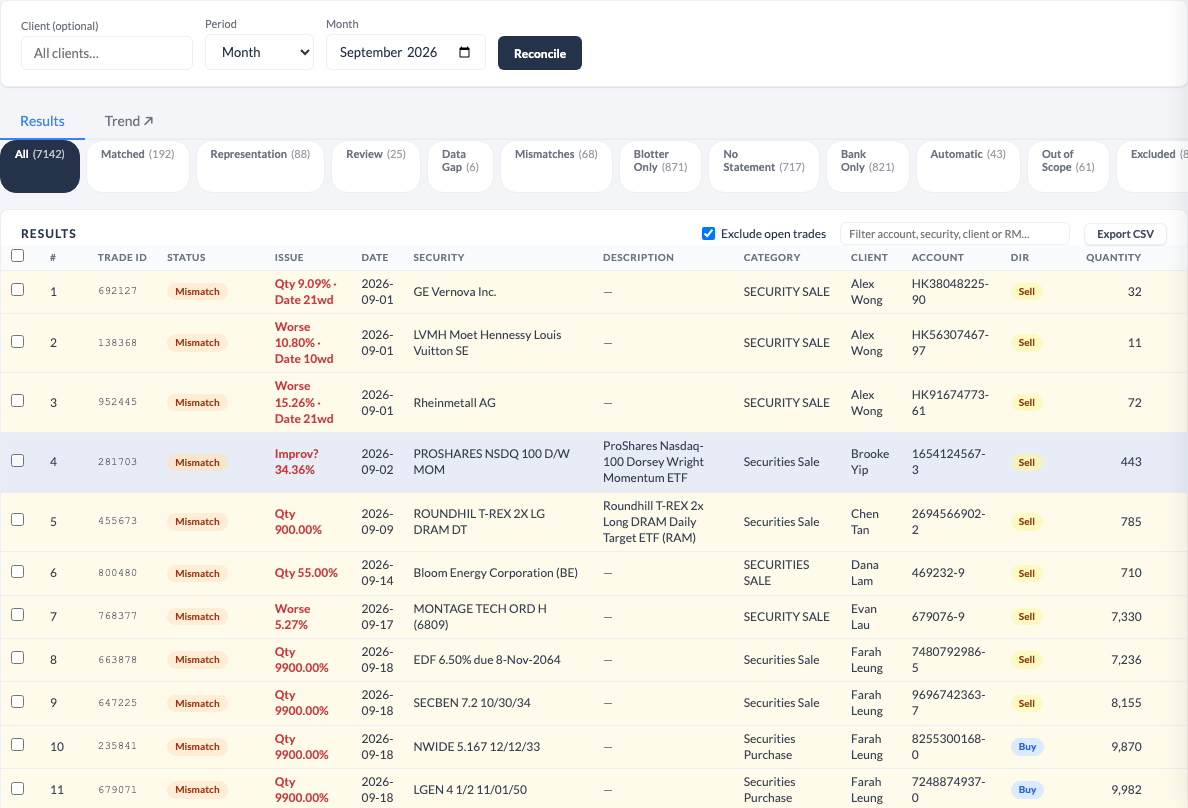
TAC Reconciliation page, with sample data
Reconciliation

Statement lines beside your books, with each difference shown by amount and by side.

Sample data. Names and figures are made up.
Custodians

Custodians and brokers TAC reads today

TAC reads PDF, CSV and XML statements from the banks and brokers below. Adding a bank means writing one new reader and testing it against that bank's real statements, as we did for the rest.

  • ACP Securities
  • Bank of East Asia
  • Bank of Singapore
  • BNP Paribas
  • CA Indosuez
  • CITIC Securities (CSIWM)
  • Citco
  • DBS Private Bank
  • Deutsche Bank
  • EFG
  • Endowus
  • Guotai Junan (GTJAS)
  • HSBC
  • JPMorgan
  • Julius Baer
  • KGI
  • Leonteq
  • LGT
  • Standard Chartered
  • UBS
  • Union Bancaire Privée
  • UOB Kay Hian
  • Vontobel
Responsibilities

Who does what

The software applies the same checks to each transaction and prepares the outputs. Our operations and compliance team investigates what the checks flag and completes the operating work in your engagement. Your principals stay responsible for the final output.

All transactions, not a sample

The checks run on each trade and each holding in scope.

An experienced team

Compliance and operations staff who have done this work inside licensed firms.

Mapped to SFC requirements

Each check refers to the SFC requirement it tests, such as the Internal Control Guidelines.

Your principals sign

We prepare the work and investigate the exceptions. Your principals review the final output and sign it.

Pricing

Cost compared with an internal hire

Each row compares an illustrative yearly fee for one TAC module (dark bar) with an illustrative yearly cost of the member of staff whose work the module supports (outlined bar). The figures are examples in Hong Kong dollars, not a quote.

TAC module, yearly feeStaff member, yearly cost

Reconciliation

Compared with an operations clerk
HK$198k
HK$600k

Accounting

Compared with an accountant
HK$178k
HK$540k

Compliance monitoring

Compared with a compliance officer
HK$240k
HK$720k

Illustrative yearly figures. Your fee is set in the signed engagement. Custom builds are priced on the value they create.

Option A

Software only

Your team runs the modules. We maintain the system and the checks.

Option B

Operated by TAC

Our team runs the modules and investigates the exceptions. Your principals review and sign the output.

Insights

Regulatory Pulse

A monthly summary of the circulars, consultations and enforcement actions the SFC publishes, with a note on what each one means for a small licensed firm. Prepared by Alpha Calibration's compliance team.

The founder

Why I built TAC.

Many moons ago, I was a COO. Much of my week went on chasing service providers: an administrator here, a software vendor there, a consultant for the bits in between.

Each of them sold me the service they wanted to sell, which was rarely the service I needed. The contracts fitted their roadmap, their pricing and their investors, and my firm had to bend to fit.

So I built TAC to fit around the firm: your banks, your rules and the way you work. It answers to its clients, not to a sales target or an investor deck.

Julian Lim, Founder

Talk to us about your firm

Tell us which custodians you use and which parts of the middle office take the most time. We will show you how TAC would handle them, module by module.